Why training routines fall apart, and how to keep yours standing

The big decision has been made. The running shoes have come out of the cupboard, the membership is bought and the first week of training goes brilliantly. Then comes that one busy Tuesday. Then a tired Thursday. Then a weekend that gets swallowed up by other plans. When you look at the calendar, you notice a month has gone by and you haven’t even seen your shoes.
Sound familiar? It isn’t necessarily a lack of willpower: a routine can be hard to maintain if you start with too much, and that is often fixable.
Why aren’t good intentions enough?
Motivation is a feeling. It rises and falls like every other feeling, and it doesn’t survive a busy daily life, bad nights’ sleep or simply a dull Tuesday evening. Building a training routine doesn’t usually work on willpower alone. It takes something more durable: habit.
A habit is different from motivation. A habit doesn’t ask for permission. It happens at the same time, in the same place, almost automatically, like morning coffee or brushing your teeth. Once training has attached itself to a certain moment often enough, you start to miss it if you skip it. At that point the routine carries you, not the other way round.
Start smaller than you think you need to
In a moment of enthusiasm, four times a week feels entirely possible. It is more realistic to start with two, or even one. According to the adult activity recommendation of the UKK Institute (a Finnish health research institute), you should train muscle strength and movement control at least twice a week, so twice a week is a good goal.
A small goal feels modest. That is exactly why it works. When a workout fits into your week without a big sacrifice or a logistical effort, it starts to feel normal. And a normal thing doesn’t need special motivation. It just happens. Add a second workout only when one already feels like a matter of course.
Put your workout in the calendar like a dentist appointment
A workout with no time booked for it is always liable to get moved. Try, just once, to think of it the same way as a meeting or a doctor’s appointment: it’s in the calendar, and moving it takes a good reason.
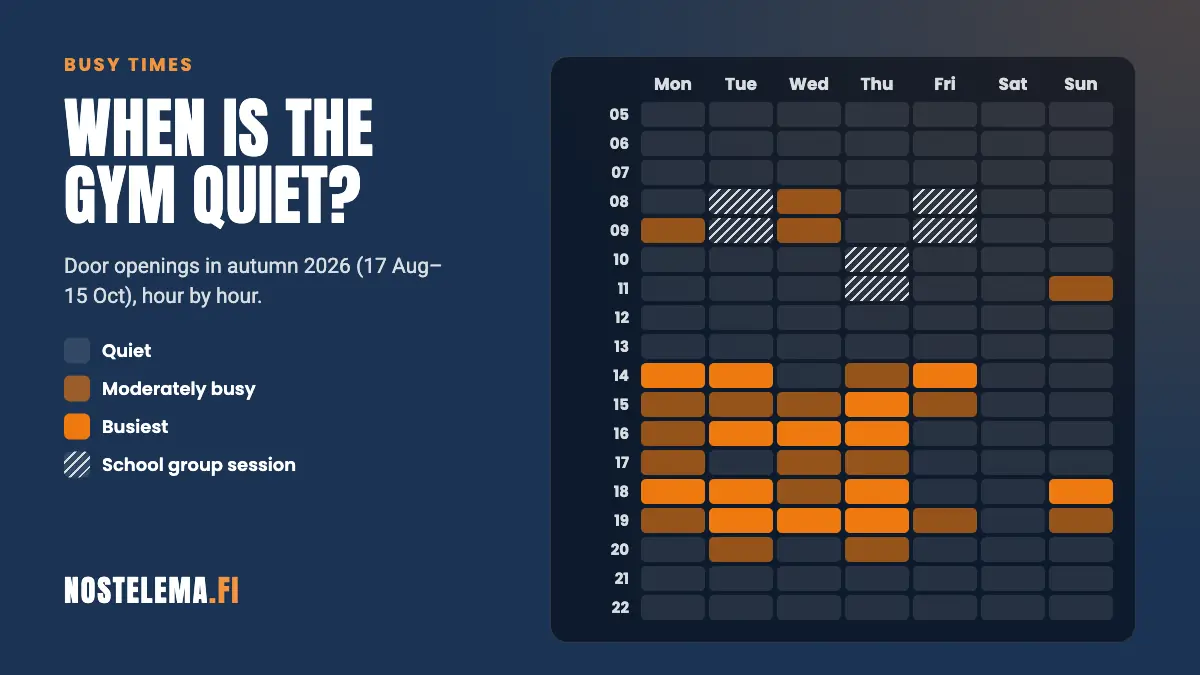
First choose the weekdays and times that suit your daily life, not some ideal version of it. If the morning before work is the only moment your head is clear, use it. If the evening after work is more natural, book that. Nostelema is open round the clock every day: with a basic membership you get in from 5:00 to 23:00, and if you like, the night hours open up with a one-time €8 24/7 upgrade, so a suitable moment can be found even when it isn’t eight in the morning or six in the evening. If you are wondering when the gym is at its calmest, see our tips on the best times.
What happens when you don’t know what to do?
One of the most common reasons a new routine fades after the first few weeks is not laziness. It is uncertainty. What am I supposed to do when I get there? If the answer isn’t clear, the threshold grows a little higher every time, and in the end you never walk through the door.
A clear programme can remove that obstacle. When you already know at home, before you set off, what you will do next and in what order, going to the gym is concrete, not a matter of talking yourself into it. As a member you can request a free training programme: our staff create it with the help of AI, check it and send it to you as a PDF by email within 24 hours.
A training buddy is motivation you can’t put off
On your own it is easy to agree with yourself that today won’t work. When a friend is waiting at the gym, going becomes suddenly much more likely, and it doesn’t even take a talk about motivation.
A training buddy isn’t compulsory. But if it’s possible, it is worth making use of. Simply being there at the same time makes training more enjoyable and more regular, and gives the routine a social anchor that is hard to slip away from.
A slip-up is not a failure
This is worth reading again: one missed workout doesn’t destroy a routine. Several in a row can weaken it, but you can pick it up again from there too.
A perfect track record is not the goal. A realistic attitude to slip-ups is. If a week goes wrong, go back to your schedule at the next possible moment, without guilt and without the thought of “I’ll start next Monday”. Carry on from where you left off. Flexibility doesn’t mean you are going easy on yourself; it means you don’t give one bad week the power to wipe out everything you have built.
A checklist for routine builders:
- Start with a small amount, for example one or two workouts a week.
- Put your workouts in the calendar like any other commitment.
- Choose a time that suits your daily life, not an ideal one.
- Get a clear programme, so you know straight away what to do.
- Bring a friend along if you can.
- After a slip-up you carry on, you don’t start from scratch.
Building a training routine into daily life doesn’t require perfect conditions or an iron will. It takes steps small enough, and enough repetitions, for a habit to form. Come at your own pace, start small and see what happens. 💪