Before you lift your first kilo: warming up at the gym

Picture this: it’s the day. You finally got your trainers on, you made it to the gym, and your favourite song starts playing just as you walk in. Motivation is through the roof. Your mind says: let’s go, straight to it. And then comes the first heavy set, a slightly stiff movement, and your shoulder feels tight.
Sound familiar? It doesn’t have to. With one small change at the start of your workout, that feeling turns into something else: your body warms up, your movements flow, and every set feels the way it should.
That change is a warm-up at the gym, and it takes only five to ten minutes.
What really happens in your body when you skip the warm-up?
A warm-up prepares your body for the load. When you go straight into a heavy set, your body isn’t ready yet: your circulation is calm and controlling the movement can feel stiffer.
Warming up raises your body temperature and gets your blood flowing, so your muscles get more oxygen. It can improve how smoothly you move and how well you control the movement, as your nervous system tunes in to what is coming. A warm-up can also help reduce the risk of injury, although it is not a guarantee.
In plain words: a warmed-up body often performs better and may stay in better shape. That is a combination worth having.
General or exercise-specific warm-up: which matters more?
Both, and they work best together.
A general warm-up raises the temperature of your whole body and wakes up your heart. Three to five minutes of brisk walking, easy cycling or the rowing machine does the job nicely. The aim is not to tire you out. It is like warming up an engine before a drive.
An exercise-specific warm-up is where warming up becomes really useful. You do the same lift you are about to put into your programme (deadlift, squat or bench press), but with a light weight. Two or three sets at 30–50% of your working weight tune your nervous system to exactly the movement pattern you need. The first heavy set often feels the hardest, when your body isn’t yet “in” the movement. This step helps you get there.
For a beginner, an exercise-specific warm-up is especially valuable: it teaches the right technique at the same time, one rep at a time, before the weights go up.
What about mobility: is it the same thing?
Not quite, but they go hand in hand. Mobility training means keeping the range of motion in your joints, and it matters more than many people realise.
Dynamic mobility work before training opens up your body for movement without taking away your power:
✔ Hip openers (for example the world’s greatest stretch or rocking squats) make all lower-body exercises easier
✔ Upper-back rotations are especially useful if you sit a lot during the day
✔ Shoulder rotator activation before an upper-body day
One thing is worth remembering: long static stretching (the traditional holding still) belongs after your workout, not before it. Right before you perform, it can briefly reduce how much force your muscles produce. Before training, move. After training, rest and stretch.
Try this: an 8–10 minute starter routine
Here is a simple frame that works for almost any workout:
✔ 2–3 min of easy walking, cycling or rowing
✔ 5–8 reps of each dynamic movement: standing hip circles (both directions), arm swings forwards and back and across the body, upper-back rotations in a squat or standing, and light bodyweight squats
✔ 2–3 sets of your main lift with a light weight
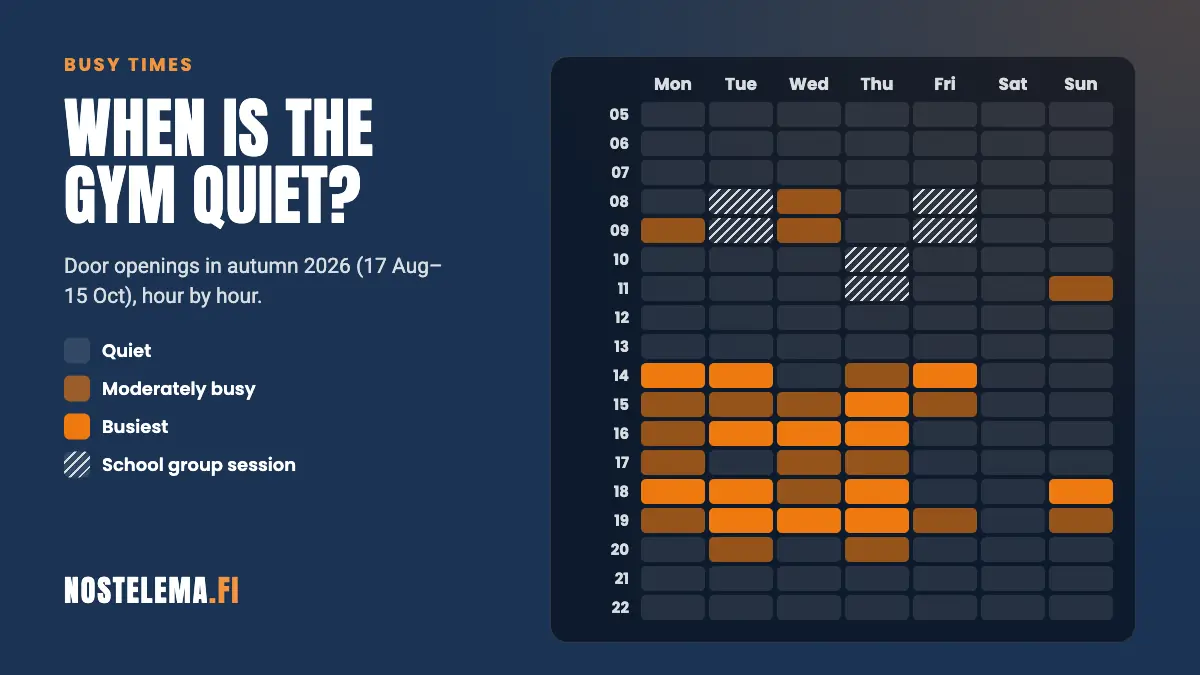
At Nostelema, the cardio and functional training area is a good fit for this. You can warm up comfortably there before moving on to the free weights area. And you don’t need to book a time. The chart shows when the gym is usually quieter.
Don’t forget the end: a cool-down helps your body settle
A warm-up has a counterpart: the cool-down. A hard workout has raised your heart rate and tensed your muscles. Stopping suddenly leaves your body halfway.
Five minutes of easy movement, such as a calm walk, and a few static stretches for the main muscle groups you trained (20–30 seconds per stretch) can help you recover and keep you feeling looser until next time. It is also a moment you can keep just for yourself: the workout is done, your breathing settles, your mind clears.
The best warm-up is the one you actually do
It really is that simple. If ten minutes feels long, start with five. An easy walk, cycle or row and a few dynamic movements are enough. Once you find your routine, it starts to feel like a natural part of training: not extra hassle, but the moment your body is given permission to join in.
If you want your whole workout to be built properly from start to finish (warm-up, programme and everything in between), members can ask for a free training programme: the staff create it with the help of AI and check it. Read more on the AI-PT page.
Welcome to the gym! We have space and time, and the gym is open 24/7. A warm body is waiting. 💪
Looking for a gym? Nostelema is a local gym in Sastamala. As a new member you now pay €28 / 4 weeks (normally €34 / 4 weeks). The offer is valid until 31 December 2026. No joining fee. An ongoing membership has no fixed term.